Archive · 2023
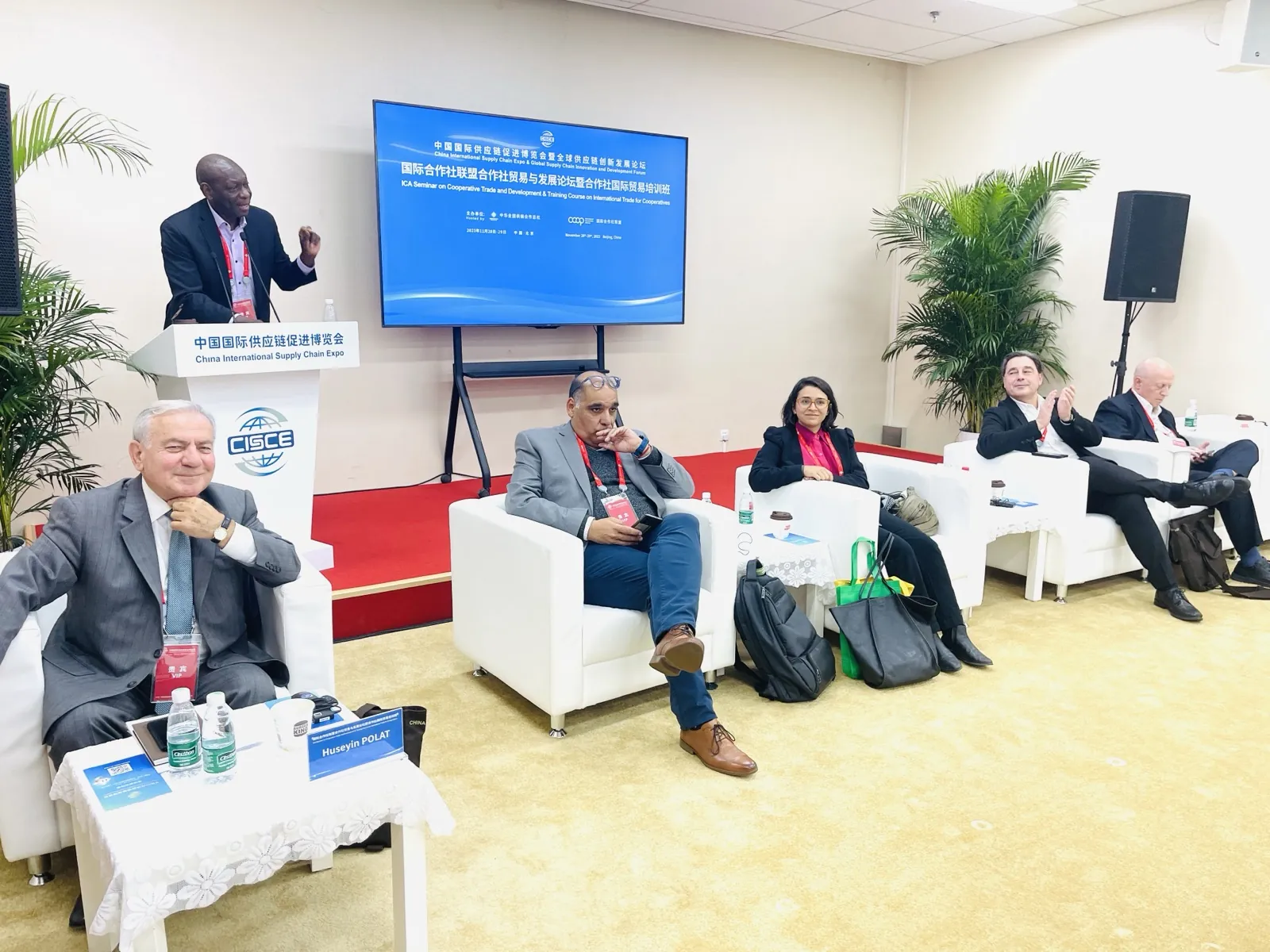
CISCE 2023 · Cooperative Trade and Development Forum
In November 2023 the first China International Supply Chain Expo (CISCE) was held in Beijing. Cooperative representatives from 15 countries across all four ICA regions — Asia-Pacific, Europe, Africa and the Americas — together with delegates from the United Nations and the International Labour Organization, attended the Cooperative Trade and Development Forum held alongside it. This column documents the forum agenda, four international cooperative presentations, and the China–South Asia agricultural cooperative training programme held in Hangzhou beforehand.
This column is compiled from the 2023 forum's presentation materials, agenda documents and publicly released press material. It is an independent research archive and does not represent the position of any organising institution.
Overview
Overview
- Countries represented
- 15
- Spanning all four ICA regions: Asia-Pacific, Europe, Africa and the Americas.
- Forum dates
- 28–29 Nov 2023
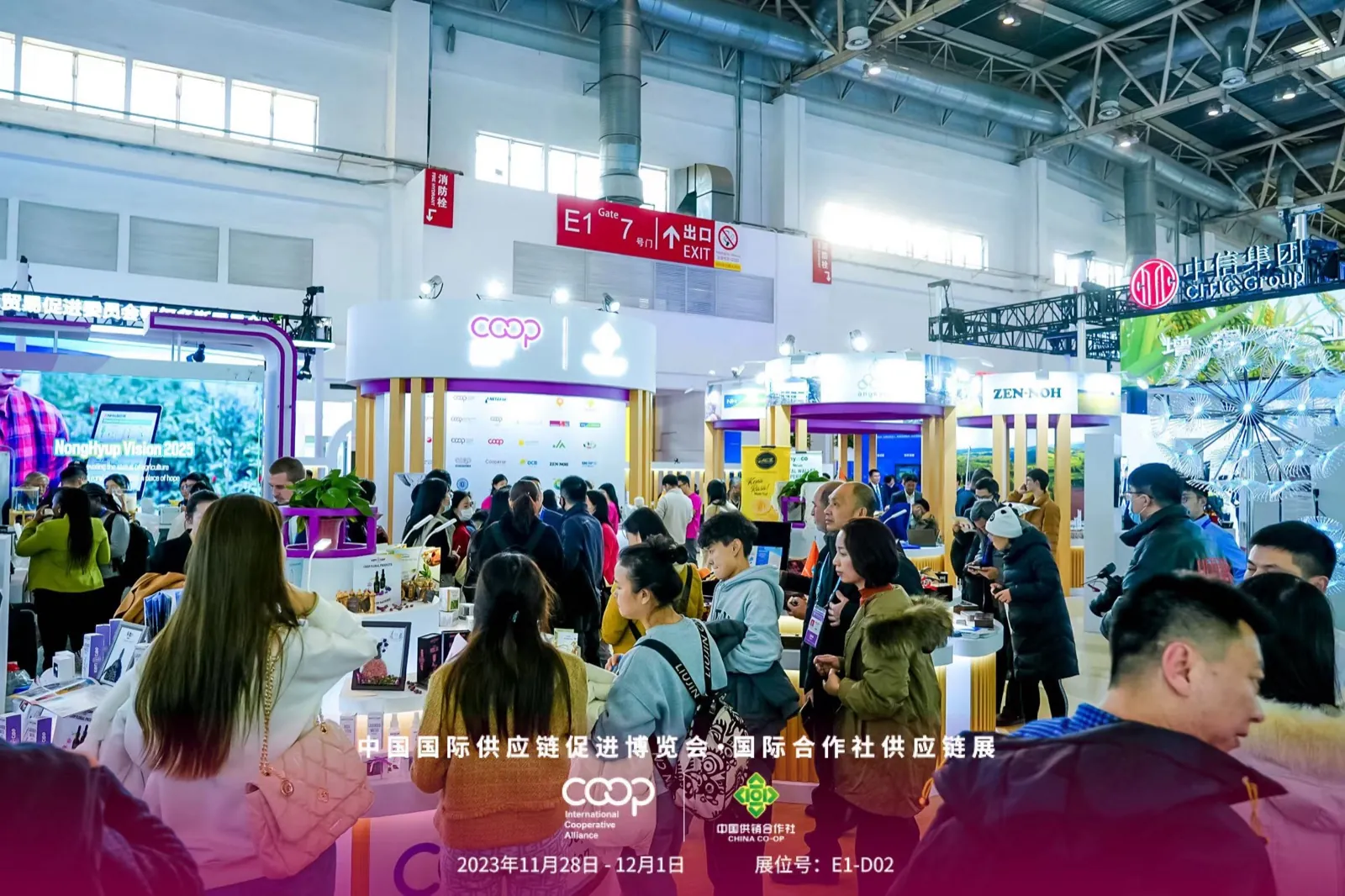
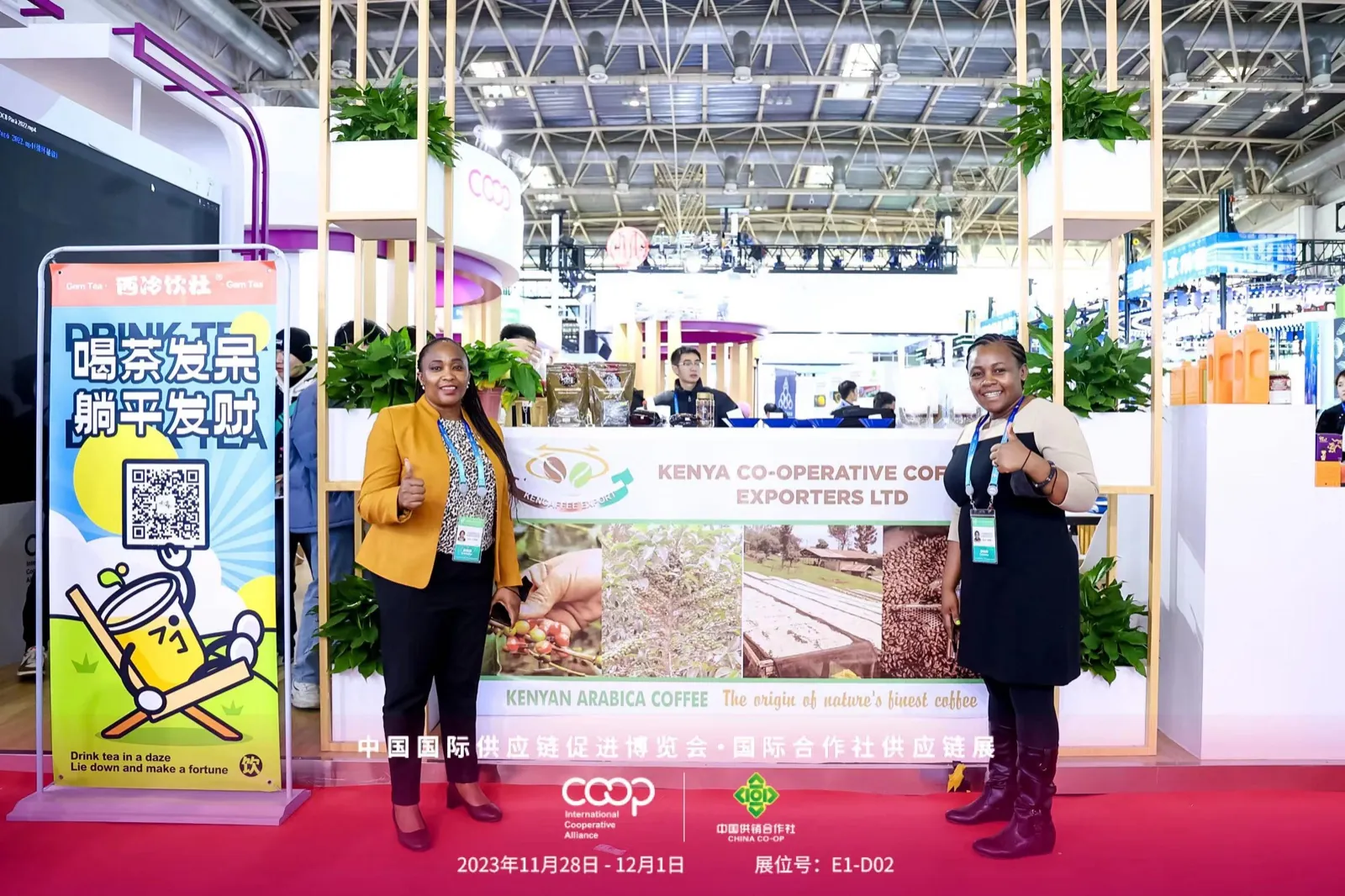
- The agenda states 28–29 November, but the schedule it contains runs through exhibitor exchanges on 30 November and departures on 1 December; the booth banner in the event photographs likewise reads '28 November – 1 December 2023'. The 28–29 dates therefore refer to the forum proper, while the exhibition ran to 1 December.
- Venue
- Meeting Room 4, Hall E1, China International Exhibition Center (Shunyi)
- Booth E1-D02.
- Thematic speakers
- 6
- The agenda lists six: Cooperar (Argentina), OCB (Brazil), NISPED (Israel), Coop Fareast (Italy), Mondragon (Spain) and ACFSMC (China), 10 minutes each. Four of the presentation decks are available and are documented here.
Presentations
International cooperative materials
AJEEC-NISPED
Israel · Agricultural cooperative system · NGO
Uses five Israeli cooperative case studies to argue that the regional cooperative model replaces the broker model with economies of scale — shifting the object of profit maximisation from the middleman to the farmer.
Read more →
Organization of Brazilian Cooperatives (OCB)
Brazil · National apex organisation
A portrait of the scale of Brazil's cooperative movement, and how OCB pushes cooperatives systematically into international trade through three strategic axes: representation, ESG and business.
Read more →
Coop Italia / Coop Far East Ltd.
Italy · Consumer cooperative · Retail
Italy's largest consumer cooperative, with private label at the core of its strategy. Its Far East sourcing office is the only direct Asian procurement arm of any Italian retailer, with 80% of volumes coming from China.
Read more →
Cooperativa Obrera, Molinera, Panadera y Anexos Ltda.
Argentina · Regional consumer cooperative
A consumer cooperative with a 30% regional market share argues why consumer cooperatives can serve as 'a bridge between producers, cooperatives and consumers' — because their goal is to serve members, not to make profit.
Read more →
Agenda
Forum agenda
Tuesday, 28 November
14:00–14:20
Opening remarks
- · Director, ILO Cooperatives Unit (online)
- · Director, ICA Asia-Pacific Regional Office (video)
14:20–15:30
Thematic session: Outlook on cooperative trade and development
- · Cooperar, Argentina (10 min)
- · OCB, Brazil (10 min)
- · NISPED, Israel (10 min)
- · Coop Fareast, Italy (10 min)
- · Mondragon, Spain (10 min)
- · ACFSMC, China (10 min)
The agenda lists Cooperar (the Argentine national cooperative confederation) as the Argentine speaker; the Argentine deck actually obtained is from Cooperativa Obrera, a consumer cooperative — not the same organisation.
15:30–15:50
Tea break
15:50–16:30
Expert panel: Actions and measures for cooperative trade collaboration
- · UN DESA (lead intervention)
- · ICA Africa Regional Office (lead intervention)
The agenda misspells UN DESA as 'UNDESO'.
16:30–17:00
Closing: Recommendations on cooperative trade and development
Wednesday, 29 November
09:00–11:00
Training sessions
- · Climate change, technological innovation and AI in cooperative trade — Hüseyin Polat
- · An integrated service platform for cooperative international trade — Ningbo Shimaotong
- · Applications of big data in international trade — Guomaotong Big Data
13:30–17:00
Product presentations (Booth E1-D02)
15 minutes per organisation, with live video streaming support.
Thursday, 30 November
09:00–17:00
Exhibitor exchanges (Booth E1-D02)
Friday, 1 December
All day
Departures
China
The Chinese side
China's supply and marketing cooperatives (2022)
- Total sales
- ¥7.4 trillion
- Profit
- ¥52.2bn
- Total assets
- ¥1.6 trillion
- Provincial / prefectural / county federations
- 32 / 342 / 2,408
- Township primary cooperatives
- 32,000
- Village comprehensive service cooperatives
- 420,000
2022 figures, as stated identically in the CISCE forum address and the Hangzhou training opening address. China's supply and marketing cooperatives were founded in 1954 as a cooperative economic organisation serving agriculture.
Foreign trade (January–October 2023)
According to the CISCE forum address, China's supply and marketing cooperatives are a significant trader of agricultural inputs, cotton, farm produce and consumer goods, with annual trade exceeding ¥100 billion. The figures below cover January–October 2023.
- Total trade
- ¥93.1bn
- Imports
- ¥56.3bn
- Exports
- ¥36.8bn
Main import categories (partial list)
- Fertiliser14.0
- Grain and edible oil12.0
- Cotton5.0
- Meat4.8
- unlisted20.5
35.8 + 20.5 = 56.3 ¥bn
Main export categories (partial list)
- Agricultural inputs11.6
- Textiles8.0
- Other non-food consumer goods6.0
- Fresh food5.0
- unlisted6.2
30.6 + 6.2 = 36.8 ¥bn
The source introduces categories with 其中 ('among which') — a partial enumeration, not a complete breakdown. The listed import categories total ¥35.8bn against ¥56.3bn in imports, a gap of ¥20.5bn; listed exports total ¥30.6bn against ¥36.8bn, a gap of ¥6.2bn. The source does not account for the remainder, and no inference is made here.
The address lists priority imports going forward as soybeans, grain, cotton, meat, sugar, food and agricultural inputs; priority exports as textiles, electronics, mechanical and electrical products, pesticides and fertiliser.
Four lines of international engagement
Driving practical cooperation through strategic partnerships
The address states that ACFSMC has established trade and economic relations with cooperatives and international organisations in over 70 countries, and signed memoranda of understanding with cooperatives and government bodies in more than 20. A comprehensive MOU was signed with Korea's NACF in 2016, and strategic cooperation agreements with Israel, Bulgaria and Poland among others.
Participating in ICA trade and economic exchanges
Since 2008 ACFSMC has attended successive cooperative expos and ICA summits, plus trade fairs in Malaysia, the Philippines, Türkiye and Thailand, sending delegates abroad on more than 200 occasions in total.
Inviting foreign cooperatives to China
The 2015 China–Europe Cooperative Summit in Shanghai; the Belt and Road cooperative product exhibition at the 2016 Western China International Fair in Chengdu; the Belt and Road agricultural products and inputs (e-commerce) fair at the 2019 CIFIT in Xiamen. More than 50 foreign counterparts were invited to this CISCE. Over ten years, the address says, foreign cooperative representatives have visited China on more than 1,000 occasions.
Supporting cooperative development in Asia-Pacific
The address states that over ten years more than ¥10 million has been invested in supporting cooperative development in Asia-Pacific, and refers to the training programme held in Hangzhou beforehand.
Three proposals from the forum
Act
The address describes cooperation among cooperatives as a shared aspiration, calling for consensus and more substantive content in exchanges between members.
Cooperate comprehensively
'We should cooperate not only in trade, but also in business networks, management training, technology application, education and R&D, and in work with women and young people.'
Solidarity among cooperatives and mutual support in international affairs
The address calls for China's supply and marketing cooperatives to be their foreign counterparts' most reliable partner in China.
Hangzhou
Hangzhou training
Walking together, building a shared future
2023 China–South Asia Agricultural Cooperative Poverty Reduction and Sustainable Development Training Programme
13–17 November 2023 · Hangzhou, Zhejiang
Guided by the ICA, hosted by ACFSMC, organised by Zhejiang Institute of Economics and Trade
Participants
30-odd cooperative representatives from 10 countries
Training press release (17 November 2023)
23 trainees from 9 countries
CISCE forum address (28 November 2023)
Two figures coexist. The press release's country list deduplicates to exactly 10 (including China) — i.e. 9 foreign countries, consistent with the address. But 23 versus 30-odd cannot be reconciled from the available material, so both are presented.
Participating countries
Bhutan, Bangladesh, Nepal, Sri Lanka, Vietnam, Pakistan, Myanmar, Malaysia, Cambodia and China
Institutions at the opening ceremony
- · Department of International Cooperation, ACFSMC
- · Zhejiang Federation of Supply and Marketing Cooperatives
- · Asia and Africa Division, Foreign Affairs Office of the Zhejiang Provincial People's Government
- · Zhejiang Institute of Economics and Trade
Programme
The five-day programme comprised thematic lectures, country reports, observation and practical training, field research, closing presentations and a summary discussion. Topics covered ACFSMC's agricultural poverty reduction experience, improving cooperative performance management to raise member incomes, the role of cooperative banks, and sericulture as a route to rural poverty reduction. Speakers were drawn from ACFSMC international cooperation, national cooperatives, cooperative banking and the International Silk Union.
Country reports
In the country report session, trainee representatives from 8 countries shared their countries' measures to promote poverty reduction and rural development, the role of cooperatives, and the challenges faced, followed by group discussion.
Field visits
- · Sericulture and Tea Research Institute, Zhejiang Academy of Agricultural Sciences — tea science and tea drinks
- · Digital Craftsman College training base, Zhejiang Institute of Economics and Trade — rural e-commerce
- · Alibaba — rural culture and tourism
“Eliminating poverty is a challenge and a mission shared by all humanity today. The hope is that through the cooperative platform, experience in poverty reduction and development can be shared, achieving mutual benefit and common development with South Asian countries.”
“Together turning the agricultural value chain into a chain of people's wellbeing.”
The press release frames the training against the tenth anniversary of the Belt and Road Initiative, describing it as upholding the Silk Road spirit of 'peace and cooperation, openness and inclusiveness, mutual learning and mutual benefit', and as building a platform for exchange between Chinese and South Asian agricultural cooperatives.
The training appears under four names across the sources; this column uses the press release's name as primary. See the editorial notes for the variants.
Editorial notes
Editorial notes
What this column covers
The source material includes speech drafts by Chinese officials and attendance lists, and some of the files also contain personal identifying information.
→ This column does not carry the names, titles or speech texts of Chinese officials, and no personal identifying information is recorded. Institutional facts stated in the addresses — system scale, trade figures, the training programme — are retained, attributed to the unnamed 'forum address' and 'opening address' so that provenance is preserved. For the four international cooperative materials, organisations and presenters are reported as their own cover slides state: these are decks presented publicly, and are of a different character.
Identity of the Argentine participant
The agenda lists 'Cooperar' (the Argentine national cooperative confederation) as the Argentine speaker. The file is named '阿根廷全国合作总社' (Argentina National Cooperative Federation). But the deck's cover slide names Cooperativa Obrera, Molinera, Panadera y Anexos Ltda. — a regional consumer cooperative — presented by Santiago Esteban, Non Food Purchasing Manager. The three do not agree.
→ This column follows the deck's own cover slide and attributes the material to Cooperativa Obrera, noting that it is a consumer cooperative rather than a national apex body. The agenda's listing of Cooperar is noted separately.
Date of the Hangzhou opening address
The opening address file is named '2023年11月10日', but the document's own date line reads '(Morning of 14 November 2023)'. The press release states the training ran 13–17 November.
→ The document's own date of 14 November is used. It is consistent with the 13–17 November programme; the filename's 10 November matches no known schedule.
Hangzhou training participant numbers
The press release states '30-odd cooperative representatives from 10 countries'; its country list contains 11 entries with Bangladesh repeated once, deduplicating to exactly 10 (including China). The CISCE forum address states that '23 trainees from 9 countries were invited'. The country counts reconcile (10 including China = 9 foreign countries), but 23 versus 30-odd cannot be reconciled from the available material.
→ Both figures are presented side by side with their sources, not merged. One possibility is that 23 counts foreign trainees only while 30-odd counts all attendees including Chinese participants — but no document says so, and the inference is not asserted here.
Name of the Hangzhou training
Four sources give four names: the press release, '2023 China–South Asia Agricultural Cooperative Poverty Reduction and Sustainable Development Training Programme'; the opening address, 'ICA Cooperative Agricultural Poverty Reduction and Sustainable Development Training Programme'; the CISCE address, 'Asian Cooperative Agricultural Poverty Reduction and Sustainable Development Training Programme'; the filename, 'South Asia Poverty Reduction Training'.
→ The press release's name is used as primary; the variants are recorded alongside.
Category breakdown of Jan–Oct 2023 trade
The address introduces category figures with 其中 ('among which') — a partial enumeration, not a complete breakdown. The listed import categories total ¥35.8bn against a stated ¥56.3bn in imports; the listed export categories total ¥30.6bn against ¥36.8bn. The source states no subtotals.
→ Presented as a partial enumeration with the unlisted remainder shown explicitly. No share-of-total composition chart is drawn, which would misrepresent a partial list as a complete breakdown.